
On 21 October 2026, Forrester released its 2027 predictions for B2B marketing and sales. One number travelled fast: AI buying agents will influence 75% of B2B purchase decisions next year. Plenty of people jumped to the obvious conclusion. If machines do the buying, why keep a sales team?
Read the predictions closely and Forrester says almost the opposite. Buyers will hand research and shortlisting to agents, then double their conversations with real people to check what the AI recommends. What does that mean for you? Your salespeople join the cycle later, but they are the ones who close it.
In this article, we look at what Forrester actually predicts and the four things to start working on now in your CRM and your content 👇🏼
AI buying agents: what Forrester actually predicts
A quick caveat up front: these are analyst forecasts. They're still worth your attention, because they describe something you're probably seeing already: prospects who show up to the first call with a comparison already done.
Here are the predictions that hit your sales numbers directly:
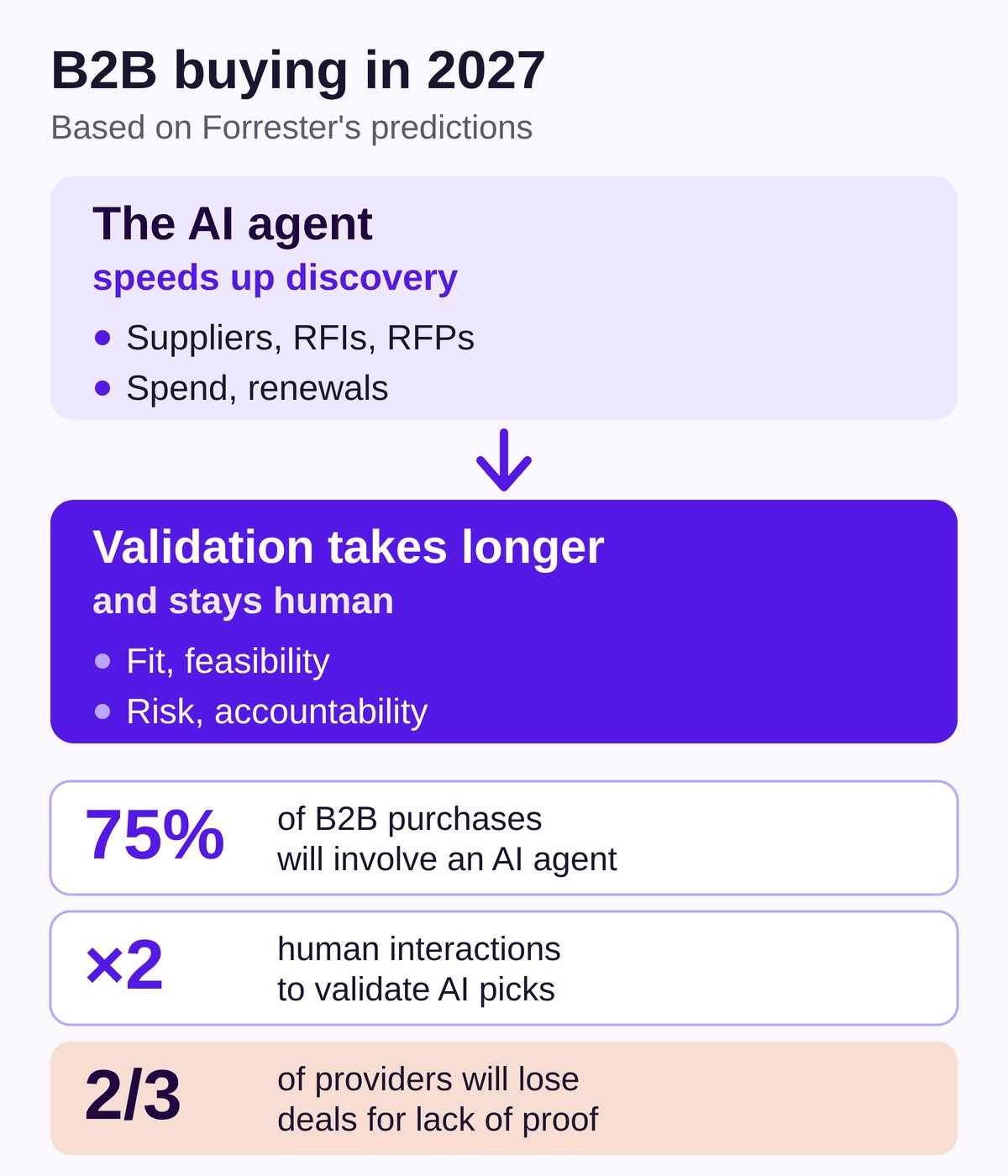
- 75% of B2B purchase decisions: AI agents will influence them, according to Forrester's 21 October press release. Forrester's 28 October blog post puts it as agents playing a role in 75% of B2B purchases.
- Twice the human contact: buyers will double their interactions with people to validate AI recommendations.
- Two-thirds of providers: they will lose deals because buyers can't verify their claims.
- Less marketing capacity: after overestimating AI gains and cutting up to 25% of roles, CMOs will have to choose between cutting programmes and accepting reduced capacity, the press release says.
That last one tells you the most. Our reading: betting that AI will replace the team has a cost, and you may only find out after the fact.
The agent shortlists, a human decides
In a 28 October post, Forrester analyst Barry Vasudevan spells out what agents will actually do. They'll handle well-defined tasks: supplier discovery, drafting RFIs and RFPs, analysing spend and contract renewals, gathering information. Fully autonomous purchasing will remain concentrated in high-volume, low-risk, repeatable buys.
Everything else, which covers most of what a mid-sized B2B company sells, will go through people. AI compares quickly, but it can't judge organisational fit, feasibility, accountability or how much risk is acceptable. Forrester puts it this way: "AI may accelerate discovery, but it will lengthen validation."
And validation now involves more people. In the same post, Forrester notes that internal buying teams have grown from an average of 8 stakeholders to 13. The post doesn't say whether that applies to all purchases or only to AI purchases, which is what that section covers. It also notes that more than half of AI purchases already involve four or more departments, compared with 26% of non-AI purchases. Legal, security, compliance, procurement, IT: each one turns up with its own questions.
Our take: don't swap your salespeople for agents
At if/else agency, we regularly see "AI projects" that start with the same question: how many roles can we save? For complex B2B sales, that's the wrong question.
If Forrester is right, salespeople lose part of their job as a source of information. The prospect no longer needs them to learn what your product does or what it costs, because their agent already found out. The salesperson becomes the person who confirms and puts their word on the line. They arrive later, facing more stakeholders, and every conversation carries more weight.
Imagine a B2B software vendor that gets an inbound request from a prospect whose agent has already compared three suppliers. The first call is then about answering the three specific objections the agent flagged, and connecting the prospect with a reference customer in the same industry. The rep who can't find that reference loses the deal, even with the best product.
That's exactly where most teams aren't ready. They have plenty of AI tools. What they lack is proof that's up to date and easy to find.
What it means for you: 4 things to work on
1. Make every claim verifiable
According to Forrester's 21 October blog post, buyers' AI tools fact-check vendor claims and expose the hollow or inconsistent ones. Imagine your website says "live in 30 days", your sales deck says "6 weeks" and an unhappy customer mentions 4 months on a forum: the agent will see all three.
- ✔ Case studies with numbers, dates and a customer name
- ✔ A security and compliance page that's kept current
- ✔ The same message on the website and in sales decks
- ❌ Superlatives with nothing behind them ("leading", "most complete")
2. Make your information readable by agents
In its 28 October post, Forrester advises making product, pricing, security, privacy, compliance and performance information accurate, structured and accessible to buying agents. In our view, a PDF gated behind a form is unlikely to get read. We covered the website side in our article on AI agents that are already filling in your forms.
3. Track the buying committee in your CRM, not one contact
According to Forrester, more than half of AI purchases already involve four or more departments. Each department has its own stakeholder, and each one needs convincing. If your HubSpot deal is linked to a single contact, you're running the sale without seeing some of the decision-makers. At if/else agency, we recommend associating every committee member with the deal, using an association label for each role (decision-maker, user, legal, security, procurement), and flagging deals in the pipeline where a key role is missing. We cover this trap in 7 mistakes to avoid in your HubSpot sales pipeline.
4. Get your experts and reference customers ready
If buyers double their human interactions, you need humans available: a product expert who can handle security questions, a customer willing to talk. In HubSpot, a simple "reference available" property on the company record, with industry and use case, lets a rep find the right reference without digging through emails or asking around the whole team. Our Sales team sets up this kind of structure during CRM projects.
Conclusion
AI buying agents should take over the first half of the B2B sales cycle. Keeping a strong sales team is still the smart call, because according to Forrester, the second half gets longer and more human.
The winners will be the vendors whose claims hold up under scrutiny and whose salespeople have the right proof at the right time. How much AI they run internally will matter far less.
Our advice: before you buy a prospecting agent, take stock of your proof. And to make sure marketing and sales keep it up to date together, start with a sales and marketing SLA.
Want to get your CRM and your team ready for AI-assisted buying? Let's talk.
Sources
- Forrester's 2027 B2B Go-To-Market Predictions: AI Agents Will Influence 75% Of B2B Purchase Decisions, Forrester, 21 October 2026
- Predictions 2027: B2B Go-To-Market Teams Must Adapt As AI Shifts Control To Buyers, Forrester blog, 21 October 2026
- Predictions 2027: AI Takes Over Business Buying, But Humans Retain Control, Forrester blog, 28 October 2026
- Cover photo by Vitaly Gariev on Unsplash